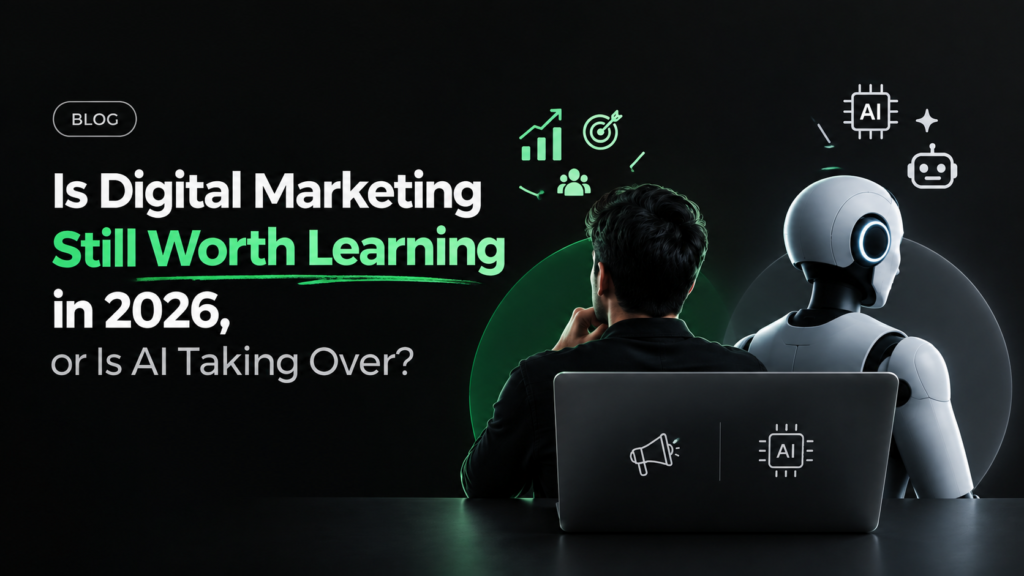
Is Digital Marketing Still Worth Learning in 2026, or Is AI Taking Over?
I get asked this a lot these days, usually by someone halfway through signing up for a course and suddenly getting cold feet. They see AI writing ads, building campaigns, and analyzing data in seconds, and they start wondering if they’re about to spend months learning a skill that’s already becoming obsolete.
I understand the worry. But after watching this industry closely, my honest opinion is that digital marketing is not disappearing. It’s changing form, and the people who understand that shift are the ones who will actually benefit from it.
Why the Panic Feels So Real
Open any social platform and you’ll see someone claiming marketing jobs are about to be wiped out. AI can write captions, generate ad variations, build email flows, and adjust ad spend automatically. It’s genuinely impressive, and it’s fast. So the fear makes sense on the surface.
But when I look closer, the fear is usually aimed at the wrong thing. AI is excellent at producing marketing material. It struggles with deciding what should be produced, for whom, and why it matters. Those are two very different jobs, even though they get lumped together in people’s minds.
A tool can spit out thirty headline options in seconds. It cannot tell you which one will actually land with a tired parent scrolling their phone at midnight, worried about whether they’re making the right choices for their family. That kind of read on people comes from experience and empathy, not from a prompt.
What Has Genuinely Changed
I won’t pretend nothing has shifted, because a lot has. Several tasks that used to take hours now take minutes.
Writing first drafts of blog posts and ad copy. Pulling and formatting analytics reports. Generating multiple creative options for testing. Adjusting bids automatically based on live performance. Scheduling posts and picking optimal times to publish them.
If someone’s entire job used to revolve around these tasks alone, with very little judgment or strategy involved, that part of the field is genuinely shrinking. I’m not going to sugarcoat that. Roles built purely on repetitive execution are under real pressure right now.
But most marketing jobs were never only that. They involved reading a room, understanding a brand’s personality, testing ideas, and figuring out why a campaign worked or flopped. None of that has gone anywhere. If anything, it matters more now, because the easy, repetitive 80 percent of the work got so much faster.
Why Businesses Still Need a Human at the Wheel
Put yourself in a business owner’s shoes for a second. AI tools are everywhere now. Canva has AI built in. Google Ads runs on automated bidding. Meta pushes AI generated variations by default. Everyone has access to roughly the same tools.
Which means the tools stopped being a real advantage a while ago. What separates a brand that grows from one that stalls out is usually the person steering things, someone who knows which numbers actually matter, who notices when a campaign that looks like it’s winning is quietly hurting trust, and who ties every decision back to a real business goal.
I’ve talked with small business owners who tried handing their entire marketing operation to AI tools with no human oversight. Content came out fast, sure, but engagement stayed flat and the messaging felt hollow. Nobody could explain why certain posts worked and others didn’t. That gap is exactly where a skilled marketer still earns their place.
What's Actually Worth Learning Right Now
If you’re weighing whether to get into digital marketing in 2026, here’s what I’d focus on.
Learn to work with AI instead of avoiding it. Get comfortable using tools like ChatGPT, Claude, and platform level automation. Knowing how to guide these tools and shape their output into something genuinely good is its own valuable skill.
Get better at reading data, not just pulling it. Anyone can generate a report now. Fewer people can look at it and know what to actually do next.
Understand people. Why do they buy, what makes them trust a brand, what makes them scroll past an ad. This has always mattered, but as AI takes over the surface level work, this becomes the thing that actually sets marketers apart.
Build real strategic thinking. Funnels, positioning, brand voice, customer journeys. These require judgment built from experience, not something a prompt can hand you.
Learn automation platforms properly. Tools like HubSpot, Klaviyo, and Zapier let you build systems that keep running without constant manual input. People who can set these up well tend to become very valuable inside a company fast.
So, My Honest Answer
If you’re planning to learn old style digital marketing, the kind built entirely on manually posting content and running basic ads with no deeper strategy behind them, that path is genuinely getting harder to build a career on.
But if you go in wanting to combine solid marketing fundamentals with real comfort using AI tools, you’re stepping into a field that’s arguably in more demand than it’s ever been. Businesses are moving online faster than ever, competition for attention keeps growing, and someone still has to make sense of all of it.
AI didn’t remove the need for marketers. It just raised the bar for what a good one actually looks like.
If you want, I can also put together a shorter version, a more casual tone, or an SEO title and meta description to go with this.